Research & evidence
Measuring what we do, and building the evidence for community cancer care.
What our members tell us...
These figures come from our 2026 Member Impact Survey (April to July 2026, 53 members).
Physical recovery
reported improved physical health and fitness. 83% of all members surveyed felt more motivated to stay active.
Emotional wellbeing
eported improved emotional wellbeing. 72% of all members surveyed felt more confident.
Social connection
made new friendships. 74% of all members surveyed felt a stronger sense of belonging.
Overall excellence
rated Cancer United as excellent. All members surveyed would recommend us to healthcare professionals for patient referral.
Building the evidence for better cancer care
At Cancer United, we don’t just deliver programmes. We measure them, publish what we find, and work with universities and health partners to add to what is known about exercise, music and peer support in cancer recovery.
Our members have taken part in peer-reviewed research with Brighton & Sussex Medical School, a doctoral study at the University of Chichester, and our own regular impact surveys. We are currently evaluating CU ON THE WARD, our exercise programme for patients in isolation on haematology wards. Together, this evidence shows what a community-based model of cancer care can achieve.
Now we want to go further. We are looking for research partners who share our ambition to make high-quality, evidence-based support part of every cancer journey.
Measuring what matters
We regularly ask our members about the difference Cancer United makes to their physical, emotional and social wellbeing. Each impact survey covers everyone who uses our services, from CUFITTER™ and OUTSINGCANCER to our support groups, so we can see what is working and where we need to improve.
2026 Impact report
Our second survey ran from April to July 2026, and 53 members took part. As well as measuring outcomes, it asked members to explain in their own words how Cancer United had helped them, giving a clearer picture of why our support works.
86% of members reported improved physical health and fitness, 85% improved emotional wellbeing, and 75% had made new friendships. Every respondent rated Cancer United as good or excellent, with 89% choosing excellent (up from 84% in 2024/25), and all of them would recommend us to healthcare professionals for patient referral. Members described a holistic model of recovery, physical, emotional and social, that complements their clinical care.
2025 Impact report
Between September 2024 and February 2025, 89 members took part in our first anonymous impact survey. That is nearly a quarter of our membership, covering many different cancer types. The survey asked about emotional wellbeing, physical health, social support, healthcare experiences and awareness of rehabilitation.
Members reported clear benefits: 71% became more positive and hopeful, 82% valued the friendships and community they found, and 96% of CUFITTER™ users improved their fitness or wellbeing. The survey also revealed a gap in cancer care: only 15% of members had heard of prehabilitation, and only 27% knew about rehabilitation services.
Research poster
The findings of the 2025 Impact report, written up by Dr Gesine Hermann, were published as a research poster, Beyond Treatment: How Community Cancer Support Improves Life After Cancer, in June 2026.
3rd Annual SCRC Symposium, June 2026, hosted by University of Sussex, University of Brighton, Brighton and Sussex Medical School (BSMS), and local NHS Trusts

Peer-reviewed research with Brighton & Sussex Medical School
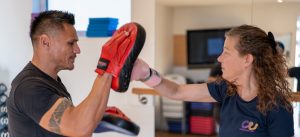
Cancer United worked with researchers at SHORE-C (Sussex Health Outcomes Research and Education in Cancer) at Brighton & Sussex Medical School to explore the experiences of people attending CUFITTER™. The findings were presented at national conferences in 2017 and published in the peer-reviewed journal Supportive Care in Cancer in 2018.
Sixty members took part. Most were over 60, and two-thirds were still having cancer treatment. Members reported being more active than before their diagnosis. When asked what they had gained most, they named improved fitness and health, and the social support of exercising with others in a similar situation. Two-thirds had made wider lifestyle changes, and 80% planned to keep up or increase their exercise.
The researchers concluded that this community-based, cancer-specific approach engaged people with cancer and brought physical, psychological and social benefits. They noted that exercise initiatives that grow out of a community bring cancer survivors together and create their own supportive environment. Combining that with instructors who understand cancer, and a service with no end date, may be especially motivating.
Catt S, Sheward J, Sheward E, Harder H, Fallowfield L (2018). Cancer survivors' experiences of a community-based cancer-specific exercise programme: results of an exploratory survey. Supportive Care in Cancer, 26(9), 3209–3216.


Singing and cancer: doctoral research with OUTSINGCANCER
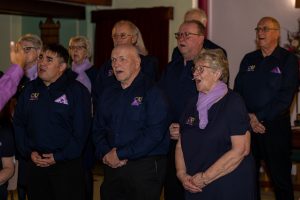
In 2026, OUTSINGCANCER’s musical director, Dr André da Silva, completed his PhD at the University of Chichester. His thesis, The Impact of Singing in a Community Choir on Cancer Patients and Their Caregivers, is based on two years of research with our own choir.
The study combined repeated wellbeing measures, taken at three points over time, with interviews and an in-depth case study. Members’ emotional wellbeing held steady throughout, even through the disruption of the Covid-19 pandemic. Members also reported significant gains in self-efficacy: more confidence, a stronger sense of achievement, and a feeling of belonging.
Singers described rehearsals as a form of mindfulness and breath training as a form of physical activity. Above all, they said the choir gave back the sense of identity and dignity that a cancer diagnosis can take away.
Because André led the choir he was studying, the research offers a practitioner’s view from inside a real community programme, which is rare in this field.
“This is a doctorate earned in church halls, with our members, and every one of them owns a piece of it.”
— Jan Sheward, founder, Cancer United
Read the thesis – coming soon
Evaluating exercise on the ward
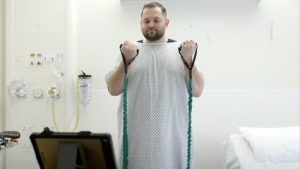
CU ON THE WARD brings exercise to people while they are in hospital. Patients in isolation on haematology wards may spend long periods in a single room with little chance to move. CU ON THE WARD gives them exercise videos they can follow in their room and a resistance band, and ward staff encourage them to take part. Our instructors are also available to talk to patients virtually, so they can get advice and support without leaving isolation.
We are running our own evaluation of how patients respond. Patients complete a short, confidential feedback form covering when they first tried the exercises, whether staff encouraged them, whether the exercise level was right, whether exercising helped them feel better during their stay, and whether they plan to keep going after they leave hospital.
We will share the findings here when they are available.

Research partnerships
We want to work with universities, NHS teams, research funders and life sciences companies to build the evidence for community-based cancer care. Our members are at the centre of everything we do, and many of them want their experience to help others.
What we offer partners
- An engaged community of people living with and beyond cancer, their families and carers, many of whom have already taken part in research
- Established programmes that can host studies, including CUFITTER™, OUTSINGCANCER, CU ON THE WARD and our cancer prevention work
- A track record of academic collaboration, including peer-reviewed research with Brighton & Sussex Medical School and doctoral research with the University of Chichester
- Experience of collecting outcome data through our regular member impact surveys
- Strong links with the NHS, Macmillan and the Surrey and Sussex Cancer Alliance
- Lived experience to inform study design, through patient and public involvement (PPI)
How we can work together
- Research partnerships and co-designed studies
- Studies of quality of life and patient experience
- Co-funded evaluations of our programmes
- Patient and public involvement in your research
- Pilots that embed exercise, music and peer support in cancer pathways
- Industry partnerships through CU IN BUSINESS™ our accreditation scheme that helps businesses support the people in their workforce and community affected by cancer.
Let's build the evidence together
If you are a researcher, clinician, funder or life sciences company interested in community-based cancer care, we would love to hear from you.
Talk to us about researchYou may also be interested in:


In this section:
Explore more of Cancer United in action...